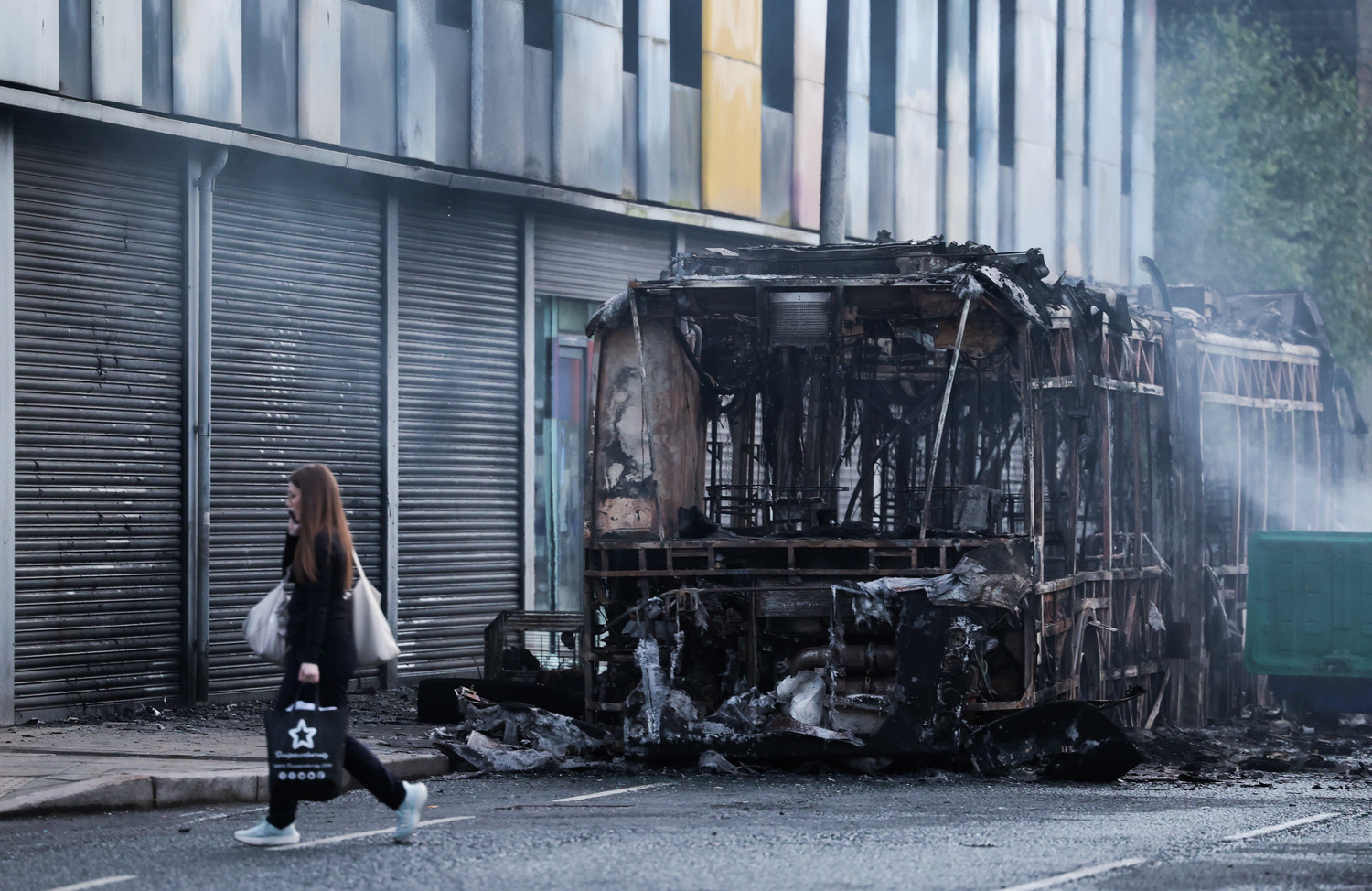
As racist attacks spread across the city, volunteers, community groups and neighbours stepped in to get families to safety, filling a vacuum left by state institutions.
====
Since Tuesday, Anaka Women’s Collective, PPR organisers and volunteers from community groups, churches and trade unions have been helping people of colour across Belfast get to safety from threatened or attacked homes.
Beyond the headlines of arson, violence, deployment of the water cannons and the statements issued by a wide range of political parties, this is perhaps the biggest story.
Ordinary people who wanted to step in to support their neighbours rallied round, at times in the face of danger, in full knowledge that state institutions would offer no effective support to families affected by racist pogroms.
They did what they knew would not be done by the state.
On the evening of Tuesday, a small group of PPR, Anaka and CATU volunteers co-ordinated and responded to more than a dozen requests received from families for help in Tiger’s Bay, Ainsworth, the Shankill, Ligoneil, Musgrave, Lendrick St.
We got 12 families to safety, either ourselves or with assistance from the PSNI. Some families went to stay with relatives and friends, others went to hotels, the issue further complicated by roadblocks and ongoing protests.
In Tiger’s Bay, at least five families requested assistance and when organisers arrived, they found themselves unable to rely on the support of the PSNI. Instead, two women helped three families out of the back of their houses, then taking them to police stations to report incidents.
This was a pattern which repeated across the city; every family who asked for our help told us that they had contacted the PSNI multiple times, waiting hours for assistance. Further west in Oakley Street, our organisers witnessed the PSNI leaving the scene as the first family was burnt out. Later seven fire engines were to attend the blaze in the street.
By Wednesday, community organisations had established safe locations across Belfast and a network of volunteers willing to transport families from threatened areas. Requests came from people whose addresses had been circulated online, while others chose to remain in their homes and needed food, medicine and practical support.
By Thursday, we estimated that we and more than 300 volunteers are supporting around 200 people across these centres. The BBC is currently reporting that 27 people have been made homeless. We believe the true number is much higher.
Despite the growing number of displaced families, neither the Department for Communities nor the Housing Executive has issued any public communications aimed at victims or contacted organisations supporting those forced from their homes.
Families will now have to face the process of reassessment by the Housing Executive, in the absence of the previous system of intimidation points which enabled rapid rehousing but was scrapped by the Minister in January 2025.
To make claims, as we have seen from Nigel Farage, that most of the people taking to the streets in Belfast were ‘fearful’ and moved by concerns around immigration is disingenuous, dishonest, and dangerous. The patterns of violence we have seen suggest something planned with intention; not the claimed outpouring of spontaneous emotion and discontent with government immigration policy.
This includes attacks concentrated in loyalist areas, the presence of paramilitary leaders in areas where attacks were taking place, the large-scale release of addresses, calls for rioters to conceal their identity and requests for the public to turn off CCTV cameras which might capture criminal activity.
In a repeat of patterns we have previously witnessed, and confirmed both by the United Nations and local bodies, the Irish News is reporting the involvement of paramilitary actors in organising and inciting violence this week.
The attempted murder of Stephen Ogilvie, like the murders of Henry Nowak in Southampton and of Bebe King, Elsie Dot Stancombe, and Alice Dasilva Aguiar in Southport, have all been the used as pretext for violent actors to ethnically cleanse areas which in their view should be white only.
There are other more significant questions for the UK Government, local councils, and elected representatives to answer, particularly around the effective use of public money to address racism.
Following the August 2024 riots, Belfast City Council was given £600,000 by the UK Government ‘to reduce the risk of further disorder in the future and rebuild social trust and promote cohesion between communities.’ Serious scrutiny of the effectiveness of the fund and examination of similar initiatives in the aftermath of this month’s violence will be needed.
As PPR has seen time and time before, families made homeless will be faced with the prospect of rebuilding their lives from the ashes, often with little or no recognition of the lasting trauma, administrative barriers and hollow offers of redress. Alongside others we will be there to help and so will the hundreds of people who in the last 48 hours have stepped in — good people acting to support their neighbours.
Chloë Trew is the director of Participation and the Practice of Rights (PPR), a human rights organisation in Belfast. You can donate to support people who have been attacked, displaced, and traumatised in racist attacks in Belfast by clicking here.