 By
By
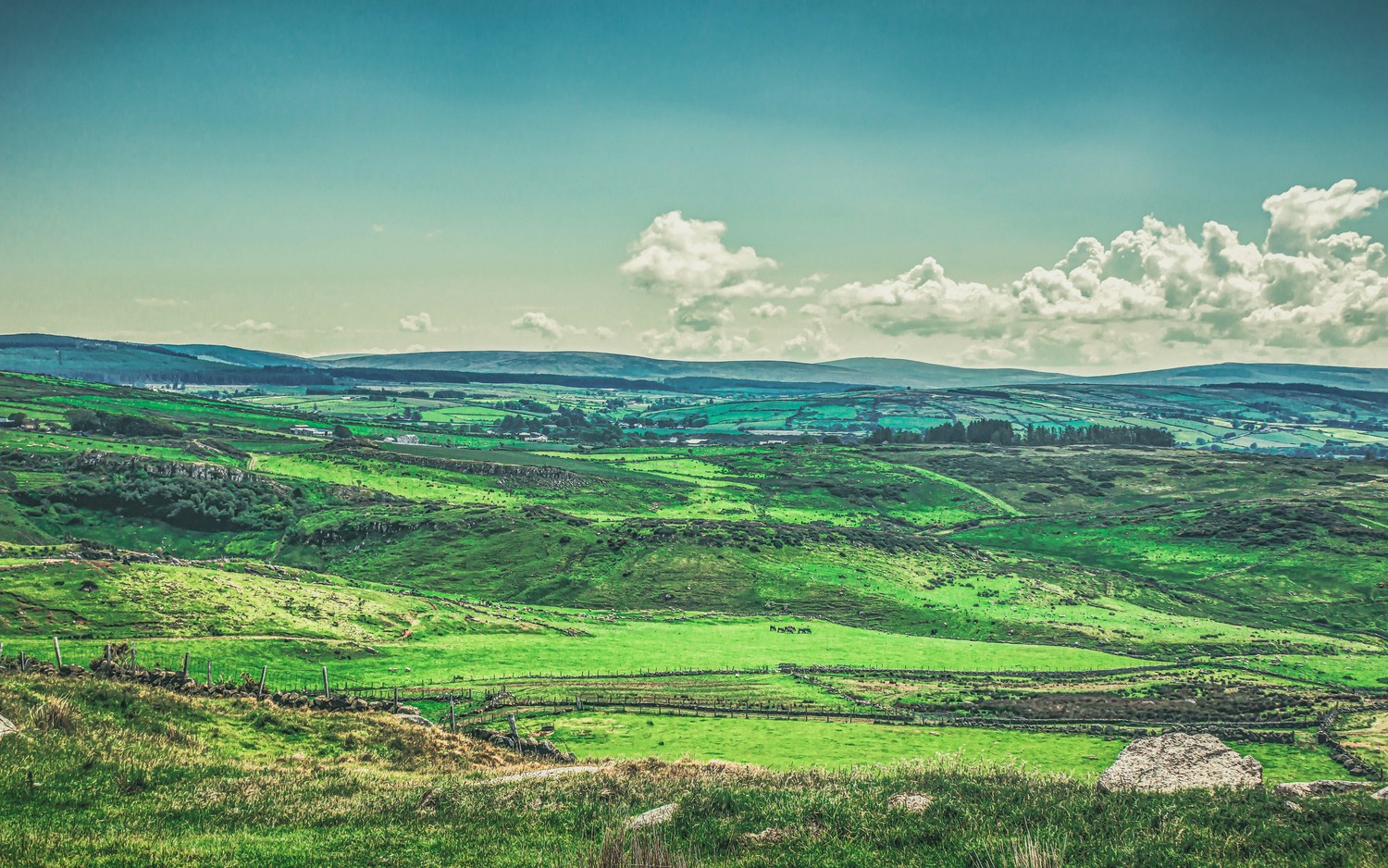
Looking out over the Glens of Antrim toward the Sperrin Mountains from Fair Head. Photo by K. Mitch Hodge on Unsplash
A gold mine in the Sperrin Mountains will have no negative impact on tourism in the area, an inquiry into the plans has heard.
But if it does, an economist speaking for Dalradian Gold suggested it “could be mitigated through a tourism fund”.
“I don’t accept there is an effect,” Andrew Hunt told the inquiry at Strule Arts Centre on Wednesday. “If there is an effect in the area surrounding the mine, it is a relatively small part of the AONB”, referring to the Area of Outstanding Natural Beauty in which the mine is located.
His conclusions were challenged by Fermanagh and Omagh District Council, tourism operators, the Ulster Angling Federation and third-party objectors.
Commissioner Cathy McKeary questioned whether Mr Hunt had “created” the criteria he relied upon, while Save Our Sperrins solicitor Mary Brolly described it as “another bespoke modelling analysis.”
Mr Hunt defended his position, saying: “It’s a matter of economic logic.
“There have to be places for tourists to spend money in areas affected by the mine. There then have to be impacts so significant that tourists would change their behaviour. Thirdly, tourists would have to alter their behaviour in ways that removed spending from the district council area or the AONB altogether.
“There is no evidence of any of those three.”
But counsel for Fermanagh and Omagh District Council, Conor Fegan, challenged the methodology used by Dalradian, describing it as “fundamentally flawed” and “contrary to planning policy”.
He argued that the criteria used by Mr Hunt had been "expressly disavowed" in a separate public inquiry into a wind farm application in the Sperrins. He said that local planning policy focuses on “an adverse impact on the intrinsic character or quality of a tourism asset, or diminishing its value”.
“We say the AONB is an asset, and they accept that,” Mr Fegan said. “That means they have breached the policy.”
‘No evidence’
Counsel for Northern Ireland Electricity (NIE) Networks, William Orbinson, said he understood Mr Fegan’s point regarding the wind farm precedent. However, he added that if there was “no evidence” of any significant reduction in tourism spending or use of the AONB that would need to be weighed against any potential breach of planning policy.
NIE Networks has applied to install more than 26km of new overhead electricity lines through the Sperrins AONB to support the proposed mine. Questions about the route were raised earlier in the inquiry and will be considered at a later date.
Dalradian also faced criticism from local tourism operator Michael Keenan, who runs Crockanboy Luxury Cabins with his wife.
Speaking from the audience, he said: “It’s genuinely terrifying how close the mine will be to us. It will bring unnecessary stress.
“What tourist would want to come to an area that has been heavily mined? Tourists crave peace and quiet, and all this will be ripped away from them.
“I strongly oppose this planning application. It will destroy the local area and our business. We have two little girls.”
Mr Keenan also raised concerns about dust, noise, traffic and emissions from the mine, as well as the proposed power lines, which he said would pass close to his cabins.
Another local resident, Emma McAleer, told the inquiry she envied people living in the Mourne Mountains and Ring of Gullion “who can sleep at night and not worry about this plight in their lives”.
“I am a local mum, passionate about heritage and rural areas and protecting them for my two young kids,” she said. “We shouldn’t have to sit here fighting for a safe environment.”
Kevin McAleer, from McAleer & Conway Construction Ltd, argued that “no one in their right mind would want to holiday” in the area because of increased traffic, dust, noise and emissions. He said the mine proposal had also created growing unease among local employers and residents.
Save Our Sperrins member Cormac McAleer highlighted concerns about increased lorry traffic on cycling routes through the area. The group’s chair, Marella Fyffe, described how the Omagh Bombing in 1998 had previously devastated her tourism business and warned the mine could have a similar psychological impact on future visitors.
She also read a statement from Peggy McGurk, who operates holiday cottages less than a mile from the proposed site. The statement argued that any jobs created by Dalradian could come at the expense of sustainable tourism employment.
Ms McGurk said she has welcomed more than 240 guests from around the world, many of whom praised the peace and tranquillity of the area.
“As a resident and business owner, I am deeply worried about the consequences the mine could have on the local environment and on the area’s appeal as a holiday destination,” she said.
Dalradian first sought planning permission to mine gold, silver and copper in Co Tyrone in 2017. The application attracted almost 50,000 objections, leading to the current public inquiry.
Visitors
Pat Haughey, who helped establish An Creagán heritage centre in 1993, also opposed the mine. He feared it would impact the centre which now attracts around 60,000 visitors annually through walking trails, cycling routes, biodiversity projects and holiday accommodation.
“We are selling the views, the mountains, the birdsong and the waters,” he said. “It’s not necessarily about places to spend money.”
Mr Haughey also warned the mine could undermine tourism initiatives being developed by four councils across the Sperrins over the past four years.
“On a clear day, I can hear a tractor two or three miles away,” he said. “They are going to be working continuously on this tailings dump. It’s going to put tourists off.
“The blasting itself will be prohibitive. Nobody wants to see armed guards, police escorts, fencing and barbed wire in a tourist area.”
Mark Tierney, representing the Ulster Angling Federation, raised concerns about the potential impact of the mine on rivers and fish species that attract anglers from around the world, including the River Foyle and River Finn.
He cited a 2007 report by PricewaterhouseCoopers for Sport Northern Ireland which estimated fishing contributes around £22.5 million to the local economy.
“Salmon are in major decline across Ireland and a lot of money has been invested in addressing that,” he explained.
“The Foyle is the jewel in the crown of angling in Northern Ireland. We have a relatively healthy run of fish and we are pushing it towards the cusp of extinction.”
In response to tourism concerns, Philip McAvoy said on behalf of third-party Dalradian supporters that operations at Tara Mines had not significantly affected tourism at attractions like Slane, the Battle of the Boyne Visitor Centre and Newgrange.
Rebutting concerns about tourism impacts, Mr Hunt for Dalradian said the Sperrins AONB covers around 118,000 hectares, while the mine site would account for “less than 2%” of the total area.
He argued that the mine’s influence on the tourism asset would therefore be “tiny” and repeated that there was “no evidence” visitors would change their behaviour.
Also speaking on behalf of Dalradian, Dr Michael Gordon said there was no dispute that the AONB was a tourism asset, but maintained Mr Hunt’s analysis contained “legitimate considerations” that should be taken into account.
Mr Orbinson for NIE Networks addressed concerns over power lines near Mr Keenan’s cabins, stating that NIE planned to use wooden poles rather than pylons and noting that around 14,000 similar structures already exist within the AONB.
Community fund
The inquiry also heard heated debate over Dalradian’s proposed community fund and whether it should be considered relevant to the planning application.
Mr Fegan argued it should not be treated as a material consideration.
Counsel for the Department for Infrastructure, Mr Elvin, referenced a Court of Appeal ruling involving gas cavern proposals beneath Larne Lough.
He said Lady Chief Justice Siobhan Keegan had found a former Department of Agriculture, Environment and Rural Affairs (DAERA) minister had acted wrongly by taking a community fund into account when approving the project.
Speaking for Dalradian, Stewart Beattie said: “If the community fund is not directly linked to the project, it is not a material consideration. Full stop.”
Following concerns that an earlier fund had supported groups far from the proposed mine, he added: “There is no requirement whatsoever for the applicant to be involved in the administration of a fund.”