 By
By
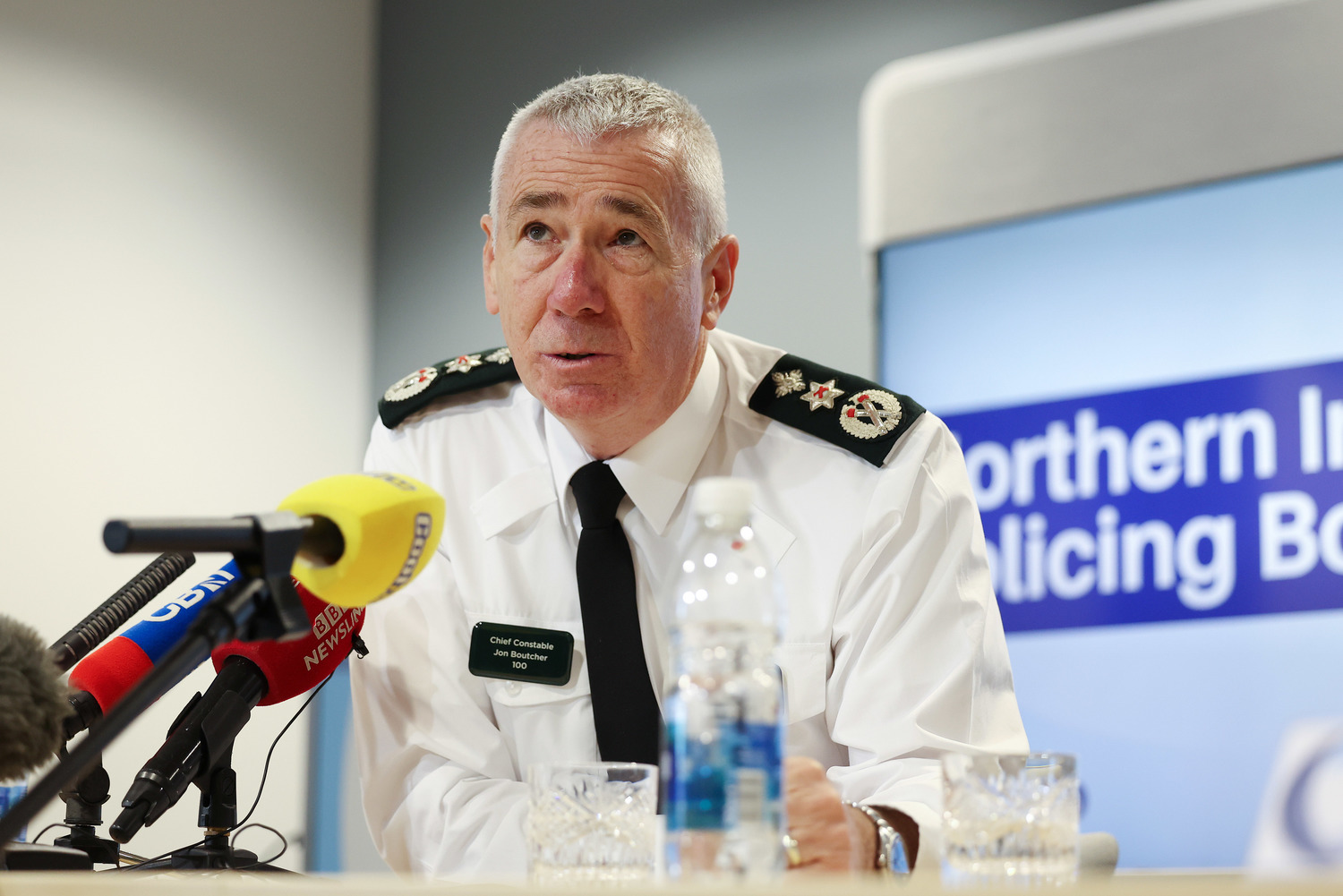
Jon Boutcher at a previous meeting of the Policing Board. Photo by Jonathan Porter, Press Eye
The Chief Constable of the PSNI has said that journalist Vincent Kearney was never treated as a suspect by the force, despite police documentation from 2013 clearly labelling him as one.
Jon Boutcher made the comments at the Policing Board yesterday, following revelations last week relating to PSNI and MI5 surveillance of Mr Kearney, a former BBC journalist.
Mr Boutcher told board members he regarded Mr Kearney as “an outstanding journalist” who had “done absolutely nothing wrong”.
“Vincent Kearney has not been a suspect in any investigations or inquiries of the PSNI,” he said.
However, a PSNI authorisation issued in 2013 to obtain Mr Kearney’s phone records appears to contradict that claim.
The document, which sought access to Mr Kearney’s incoming and outgoing calls and subscriber details in order to identify his confidential sources, states:
“The user of this telephone number [Kearney’s] is a suspect in the above investigation and the information sought is needed to identify the suspect and other criminal associates.”
The application was made as part of Operation Samarium, an investigation into allegations that a senior member of PSNI management had received corrupt payments.
Barry McCaffrey, a former journalist with The Detail, also had his phone records unlawfully obtained during the same operation and was wrongly described as a “suspect” in near-identical language.
Patrick Corrigan, of Amnesty Northern Ireland, said “the Chief Constable must not seek to minimise what happened here.”
“The PSNI unlawfully interfered with the rights of Vincent Kearney - one of Northern Ireland's most respected journalists - treating him as a criminal suspect in order to identify his confidential sources. This is not an isolated incident. Barry McCaffrey was subjected to the same treatment,” he said.
"We look to Jon Boutcher to be the new broom - not a Chief Constable who brushes wrongdoing under the carpet.”
Mr Corrigan repeated his call for a public inquiry into surveillance by MI5 and other police forces conducting surveillance activities in Northern Ireland.
“Misinterpreted”
At the same Policing Board meeting, Mr Boutcher said politicians and the media had continued to ‘misinterpret’ revelations emerging from the Investigatory Powers Tribunal (IPT) about the extent of police surveillance of journalists.
He said the evidence heard by the tribunal last week did not contradict the findings of the McCullough Review, which concluded that surveillance of journalists by the PSNI had not been “widespread or systemic”.
“Nothing that I’ve heard suggests that McCullough has missed anything with regards to severity,” Mr Boutcher said when challenged by board members.
Mr Boutcher told the board that the McCullough review had deliberately avoided examining cases currently before the IPT until those proceedings were completed.
“There is no need for any public inquiry here. This isn’t what everyone thought it was. McCullough said that to this board when he introduced the report,” Mr Boutcher said.
“The reporting then did exactly what McCullough said you did before, you misinterpreted disclosure to the IPT, he told this board that. And then this board and the media misinterpreted what McCullough said. And you are continuing to do that.”
However, chair of the policing board Mukesh Sharma said that they were “merely trying to do our job as an accountability body.”
“We have no cause for getting into a situation where we are making up things or doing what you are suggesting,” he said to Mr Boutcher.
Profile
The chief constable also declined to answer questions about aspects of the surveillance of Mr Kearney, including why a detailed “profile” of the journalist had been created that included members of his family, and whether profiles were made of any other journalists or lawyers, citing the ongoing tribunal proceedings.
However, Mr Boutcher said that “there should be no PSNI examination of him and his family”.
Submissions to the IPT allege that the extent of surveillance carried out by MI5 and the PSNI on Mr Kearney was “unprecedented”.
They claim a detailed profile compiled by the PSNI included his date of birth, home and work addresses, landline and mobile phone numbers, vehicle registrations, the names of his wife and mother-in-law, and details of who was living at his address at the time.
The profile also listed the number of articles written by Mr Kearney and the subjects of those reports.
Lawyers representing the journalist have argued that the scale of the information gathered has had “a real and significant effect” on his life and that “the range and scale of this personal information has caused particular distress”.