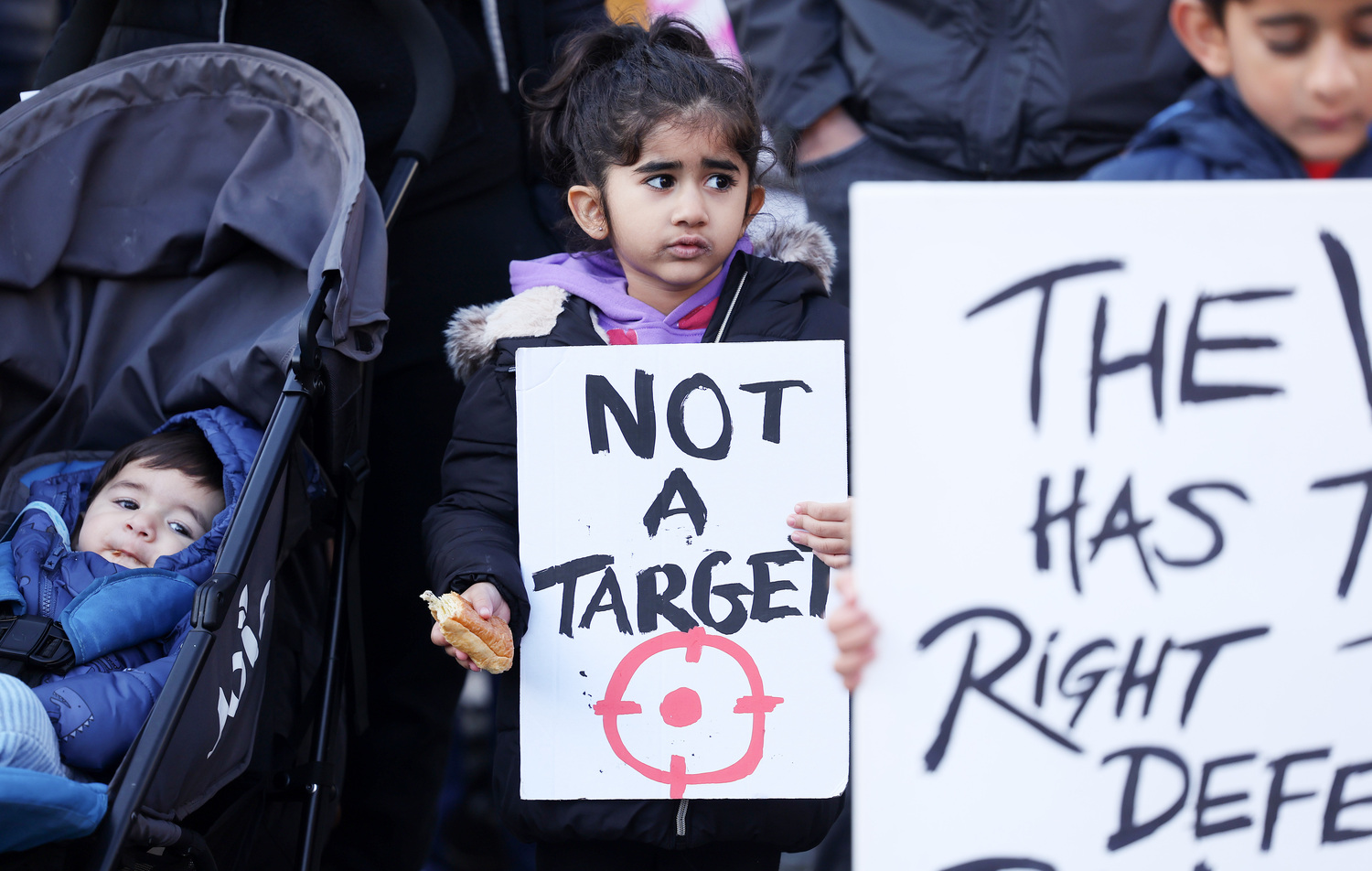
A child at an anti-racism rally in Belfast following a surge in racist attacks in the city in 2024. Photo by Jonathan Porter, Press Eye
Racist attacks in Northern Ireland are consistently concentrated in a relatively small number of neighbourhoods, The Detail can reveal.
More than 23% of all race hate crimes over the past decade were recorded in just 1.5% of Northern Ireland’s electoral wards, according to an analysis of data published by the Northern Ireland Statistics and Research Agency (NISRA).
The figures also suggest there is no simple relationship between the number of recorded attacks and the proportion of minority ethnic residents in an area, nor whether the area has a majority Catholic or Protestant population.
The data comes amid a sharp rise in racial violence across Northern Ireland.
In June 2026, Belfast was rocked by a wave of racist violence after a list purporting to identify the addresses of migrants circulated online. Homes were attacked and immigrants were forced to flee, with some of the violence reportedly linked to paramilitary organisations, including the Ulster Volunteer Force (UVF).
A leading migrant rights organisation in Belfast said the figures illustrate the impact of rising anti-immigrant hostility.
“It goes beyond the actual rioting and the displacement of people,” said Takura Donald Makoni, a policy officer at the African and Caribbean Support Organisation Northern Ireland (ACSONI).
“People are traumatised; people who have to travel on public transport are scared to.”
According to NISRA, 1,507 racially motivated hate crimes were recorded in the most recent year covered by the data. That was more than double the 654 incidents recorded in 2016/17.
But the overall rise has not been evenly distributed across Northern Ireland.
An analysis of electoral ward-level figures shows that some neighbourhoods have experienced persistently high numbers of reported incidents, while others have seen sharp increases more recently.
Northern Ireland has 462 electoral wards, which differ in size and population density, across its 11 local council areas.
Just seven of these wards accounted for 2,026 of the 8,665 recorded race hate crimes over the past decade. Many other wards—nearly 40%—recorded no incidents at all.
Three Belfast wards — Central, Blackstaff, and Duncairn — featured among the ten areas with the highest numbers of recorded race hate crimes in every year between 2016 and 2026.
The East Belfast wards of Woodstock and Beersbridge and Water Works, in the north of the city, as well as Castle Demesne in Ballymena, featured among the ten areas with the highest numbers of recorded race hate crimes in at least five years in the past ten.
Across the ten-year period, 34 different wards appeared among the areas with the most recorded race hate crimes.
There was, however, considerable variation between years, suggesting that severe spikes in reported incidents can also emerge in areas not usually among the worst affected.
Ardoyne in Belfast, and Mountsandel in Coleraine, were among the wards that appeared just once during the period.
Other wards also have experienced substantial increases in recorded crimes over the past year. In Ballymacarrett, in East Belfast, for example, the number of racially motivated crimes reported in the past year was up 66% from the previous year.
And in Belfast’s Shankill ward, that shift was even more prominent, with the number of reported crimes nearly tripling, going from 16 to 45 reported crimes in the past year alone.
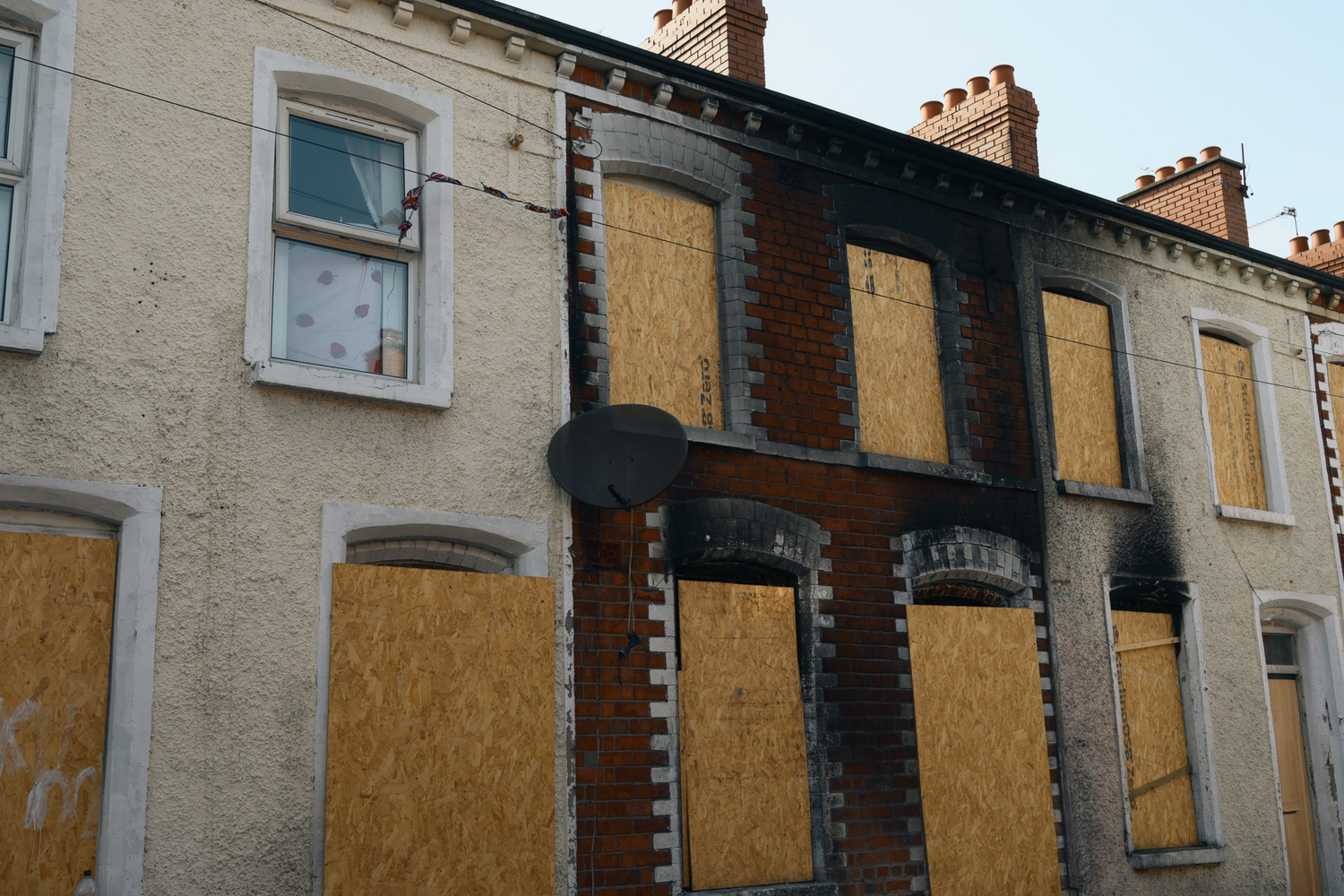
Destroyed homes in East Belfast following anti-immigrant riots in June 2026. Photo by Hannah Epstein, The Detail
Race, nationality, and community background
Of the seven wards that appeared in the top ten most frequently over the decade, five had larger Protestant than Catholic populations.
Some had substantial Protestant majorities, while others were more mixed. Others, such as Water Works, had a majority Catholic population and also featured regularly among the areas recording high numbers of race hate crimes.
Looking at the wider group of 34 wards that appeared in the top ten at least once, wards with Catholic majorities and those with Protestant majorities were represented in broadly similar numbers.
The wards that most frequently had the highest number of race hate crimes also generally had higher than average proportions of residents born outside the UK and Ireland.
Across these seven wards, the figures ranged from 11% to 35%, compared with a Northern Ireland average of 6.5%. Most residents born abroad come from Europe.
However, other wards with similarly high proportions of residents born overseas recorded relatively few race hate crimes.
These include Corcrain in Portadown, Killymeal in Dungannon, and Cookstown East.
Other measures of ethnic diversity tell a similar story. According to R.I.S.E., a monitoring platform focused on transparency and accountability in Northern Ireland, just 4% of Shankill residents identify as non-white.
By comparison, Ormeau and Stranmillis have non-white populations of around 12% — three times the proportion in Shankill — but substantially lower rates of recorded race hate crime.
For Chloe Trew, director of the Belfast-based human rights organisation Participation and the Practice of Rights (PPR), the figures suggest that demographic explanations alone are inadequate.
“The idea that there is a simplistic correlation between increasingly racially mixed populations and hate crime doesn't seem to be supported,” she told The Detail.
“It seems clear that there are other factors contributing to these dramatic levels of hate crime in some areas which point to an organised and targeted approach which is either benefitting from, or driven by, some kind of existing supportive or protective infrastructure.”
Response
Makoni from ACSON said that responsibility for addressing the rise in anti-immigrant hostility should not rest solely with the police.
“I do believe that PSNI has a lot of work to do, and they have been forewarned to create a sufficient response to this drastic rise, especially when it comes to the rioting.”
“(But) the PSNI works within a framework, and they are funded by those who manage that framework,” he added.
PSNI superintendent Joanne Gibson told The Detail that “there is no excuse for hate crimes and incidents which have a devastating impact on victims, their families and communities.”
“The increase in racially-motivated hate crimes over the last year is concerning and we will be consistent and unequivocal in our response,” she stated. “We will continue to police this type of criminality robustly and do everything in our power to bring anyone who commits a hate crime to justice.”
She added that the PSNI “have high visibility patrols at locations such as hospitals, mosques and other sites that provides reassurance to show how serious we take hate crime incidents against members of our communities."
A spokesperson from The Executive Office stated that they are “taking forward a new Framework for Race Relations and Delivery Plan which will help shape the longer-term approach to advancing racial equality, tackling racial disparities and promoting positive race relations across society. We are currently considering the 700 responses received to a call for views.”
“In the wake of the recent disorder, we are also supporting practical initiatives including integration activities and Community Support Hubs in each Council area, the Minority Ethnic Development Fund, the Planned Interventions Programme, T:BUC Camps and the recently established Response Fund.”