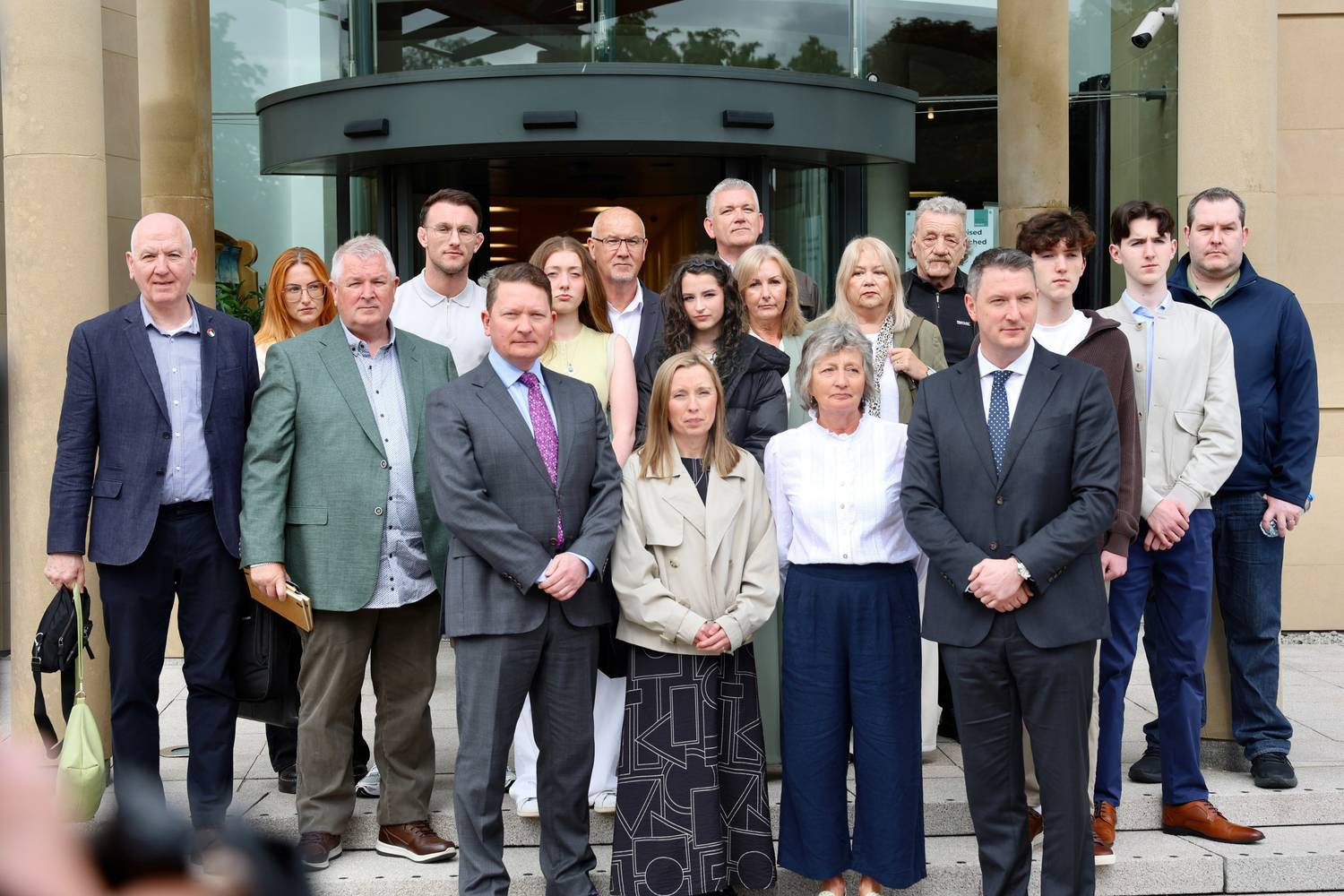
The opening of the long-awaited public inquiry into the murder of Belfast solicitor Pat Finucane was yesterday marked by British government and PSNI promises of full and proper cooperation.
Both now insist they are committed to helping uncover the truth behind one of the most controversial killings of the Troubles.
Yet those assurances raise a question that has haunted the Finucane family for more than 37 years: if the state is now committed to providing answers, why has it taken so long to allow a public inquiry?
For decades critics have accused the British government of operating a cynical 3Ds policy of “Denial, Delay and Death”.
The government has been accused of deliberately blocking public inquiries which could expose state wrongdoing in issues such as Covid, Grenfell Tower and hundreds of collusion killings in Northern Ireland.
Since 1989 the Finucane’s have faced denial that there was state collusion in his murder; repeated delays in long running legal battles in the belief that campaigners would eventually die of old age without securing a public inquiry.
Yesterday three generations of the Finucane family attended the opening hearing of the public inquiry into the murder of the human rights lawyer, who was shot dead by loyalist paramilitaries in front of his wife and three children at their north Belfast home in February 1989.
Inquiry chairman Sir Gary Hickinbottom granted special dispensation to allow teenage members of the family to attend because of the significance of the occasion.
Patrick Finucane’s widow, Geraldine, described the opening of the inquiry as a “momentous day.
Speaking on behalf of a range of government departments, including the NIO, Home Office, Ministry of Defence, Cabinet Office and Intelligence agencies, Peter Coll KC said the hearing marked an important milestone.
“This preliminary hearing marks a significant step in the progress of the inquiry and my clients are committed to continue the ongoing engagement to assist the inquiry in its important work,” he said.
Mr Coll acknowledged the efforts of the Finucane family in their pursuit of answers into their loved one’s murder.
“On behalf of the UK government it is acknowledged and recognised that this is a very significant day for the Finucane family,” he said.
Mr Coll said that in 2012 then Prime Minister David Cameron’s 2012 had admitted the “frankly shocking levels of state collusion” in Mr Finucane’s murder.
Mr Cameron apologised for the killing but rejected calls for a public inquiry, citing the significant financial cost to taxpayers.
Repeating that apology, Mr Coll told the hearing: “On behalf of the government and the whole country, let me say again to the Finucane family, I am deeply sorry.
“I hope that this inquiry will finally provide the information that the Finucane family has sought for so long.”
The PSNI also pledged full cooperation with the inquiry.
Laura McMahon KC, representing the police service, said the organisation accepted that it had failed the Finucane family.
“In 2012, following the De Silva report, the then Chief Constable offered an unconditional apology and accepted that the Finucane family had been abjectly failed,” she said. “That serious issues arise from Mr Finucane’s murder is very clear.”
Ms McMahon said the PSNI would now “engage constructively in this process and do all it can to assist the inquiry in its important work”.
However, she warned the PSNI faced significant challenges, including the recovery, review and protection of sensitive intelligence material that the inquiry may wish to be scrutinise.
“In making these remarks about documents we are not seeking to identify problems, but it is important that everyone understands the scale of the work,” she said.
“The work has to be done properly and comprehensively to ensure that this inquiry can achieve its goals and do so within a reasonable period of time.”
She added that the PSNI would take a “positive and constructive approach”, provide full cooperation, disclose all relevant material and dedicate extensive resources to supporting the inquiry.
Inquiry chairman Gary Higginbottom described the murder of Mr Finucane in front of his children Michael, then 17, John, 12, and Katherine, eight, as “horrific” and one of the most controversial killings of the Troubles.
He praised the family’s campaign for truth and accountability, saying they had pursued their cause “tirelessly” and “with great dignity” for nearly four decades.
Despite five previous state investigations into the murder, Mr Higginbottom said the inquiry expected to gain access to material that had not been available to earlier investigations.
There was no explanation why this evidence had been withheld from the five previous state investigations.
Mr Higginbottom said the inquiry’s purpose was to establish the circumstances surrounding the killing, identify all those involved and determine the nature of their involvement. However, he stressed that the inquiry was not empowered to determine criminal liability.
Instead, it would make findings of fact and recommendations.
He also issued a warning to public bodies responsible for disclosure.
“It is an offence intentionally to alter, destroy, suppress or conceal documents known or believed relevant to our investigation,” he said.
Counsel to the inquiry, Matthew Hill, said the scale of the task should not be underestimated. He described the case as the product of more than 30 years of formal and informal investigations, “where only the tip of the iceberg has been seen by the public”.
Mr Hill said the inquiry would examine the roles played not only by those directly involved in the murder but also by the British Army, the RUC, the Security Service, politicians and civil servants.
For the Finucane family, barrister Danny Friedman KC said the impact of the murder continued to shape the lives of Geraldine Finucane, her children and grandchildren.
He rejected long-standing allegations that Patrick Finucane had been a member of, or unduly sympathetic to, the IRA. Instead, he pointed to the family’s diverse background: one sister had married a former British soldier, another brother had entered the priesthood, and Mr Finucane himself had married Geraldine, who came from a Protestant middle-class family in east Belfast.
Mr Friedman said the family believed it was “high time that the truth was reckoned with” regarding the extensive allegations of state involvement in the killing.
The inquiry also heard from representatives of three former RUC detectives who claim their efforts to bring those responsible to justice were obstructed.
Clare Dobbin KC said former detectives Johnston Brown, Trevor McIlwrath and Alan Simpson had “waited years” for an opportunity to give evidence in a forum capable of uncovering how their investigations had been “frustrated and impeded by others and what this truth reveals”.
The inquiry will now not sit again until September.
However, the central issue remains unchanged: Have the 3D’s been decommissioned?
Will a process repeatedly denied to the Finucane family for almost four decades finally answer the questions that successive investigations failed to resolve.