 By
A new book investigating the tale of the pollution scandal that has gripped Lough Neagh for the past three years launches this week.
In this extract from 'Troubled Waters', journalist Tommy Greene takes us back to when the problems at Lough Neagh started to make international headlines.
==
FOR RICKY HOLMES IN ANTRIM town, it was not so much a sight as a smell that he says alerted many residents to what was an unwelcome presence. Some of the town’s inhabitants could smell it half a mile from the shoreline.
Alarm bells had already been ringing for some time. In May 2023, a couple of months earlier, Ricky had noticed collections of small green globules glistening throughout the water of the lough. He would regularly dunk his head under the lough’s surface either alone or as part of weekly community-led swimming sessions on the opposite side of the northern shoreline, by the Ballyronan townland’s redeveloped marina. To begin with, he was passingly intrigued, yet relatively unperturbed, by the luminous green particles that were floating around him as he swam by. However, their rapid rate of accumulation soon had him unnerved and kept him out of the water for months.
‘It started off as a kind of green glitter in the water,’ he said. ‘And then, as the weather warmed up a bit more, it started to congeal. As the weeks – or even days – passed, it just spread more and more and more. We soon ended up with this green sludge that people saw collecting on the surface of the water, on rocks, everywhere.’
Towards the end of June, Holmes drove along the lough’s northern shoreline with a friend to the nearby parish of Cranfield. By the ruins of a thirteenth-century church, a well-known pilgrimage site, he and his companion began to capture photographic evidence of this viscous, blue-green slime. ‘Within five minutes of being there, my head was splitting,’ he says.
Other members of the Ballyronan Bluetits, a community-led open-water swimming group, noted the appearance of rashes and lesions across their skin. They were symptoms brought on by contact with something described by nearly all eyewitnesses as ‘otherworldly’. Mary O’Hagan, the group’s co-lead, remembered how, around this time, fluorescent purple pools also started developing alongside the multiplying blue-green material. Whatever the substance was, this was more than just a scattering of bright fragments now. It was growing, increasing exponentially by the day.
‘I suspected it was something unusual, not good,’ she said of the sparkling green specks that Holmes and other swimmers had noticed. ‘But I didn’t know it was blue-green algae at that point. And then, I would say, within a few days of that, there was a patch of red algae that showed up on the beach at Ballyronan. Really nasty-looking stuff. I thought it was a chemical spillage, that somebody had maybe spilled red diesel.’ Its visual appearance was arresting, she said. ‘It was so vibrant – almost like fluorescein – that I thought someone had put something into drains to trace it and that it was coming up there on the beach. At the same time as it was there, the blue-green algae had started to gather on the slipway at the marina in Ballyronan, where the boats are all docked.’
O’Hagan was straight on the phone to a council pollution hotline as soon as she got back to her home in the nearby town of Magherafelt. Within a few days, the presence of blue-green algae was confirmed and the ‘red patches’ – by now, slightly dispersed by dogs running through the discoloured shore-line waters – were also confirmed, to her surprise, as another kind of ‘algae’.
The term algae is something of a misnomer here. Rather than a naturally occurring plant species, it was actually a kind of photosynthesising bacteria covering the great expanse of water larger in surface area than Malta. It began making headlines within a matter of weeks.
Mary recalled, ‘It just got worse and worse from there. It just got thicker and soupier. There wasn’t any let-up from it at all from there on in.’
Speaking a year later, her swimming group was still being blighted by the noxious bacterial growths that had started more than a fortnight earlier than in 2023 – possibly at even greater levels. When I spoke with her, she had just been contacted with photo evidence of rash outbreaks by those still brave enough to glide through the lough’s connecting waterways. She showed me images of an all-body rash lasting four days. Her colleague’s skin exhibited a succession of pink smudges and streaks that had spread across her arms, torso and legs.
In the case of forty-two-year-old Gerard McCourt, a seventh-generation fisher from around Derrylaughan, by the lough’s south-western corner, ‘a splash of it in the mouth’ when out working the lough’s waters was enough to keep him bedbound for nearly a fortnight. For government scientists at the time, there was some initial scepticism concerning the physical symptoms being reported by users and residents around the lough. But they would soon discover these were not simply psychosomatic or panicked exaggerations brought on by the sudden change to their immediate environment.
Standing by one of the locks at Toome canal, just a stone’s throw from the headquarters of Lough Neagh’s famed commercial fishery, McCourt told me: ‘The lough’s been absolutely disgusting this year. We’ve barely been able to get out onto it.’ He was not exaggerating. The smell that the vast waterbody was giving off during this time was foul. To call something ‘rotten’ or ‘stinking’ is to signal a general – and sometimes quite banal – kind of disgust in the local vernacular. But this was unmistakably the putrid odour of something decomposing, a choking stench of ammonia and hydrogen sulphide.
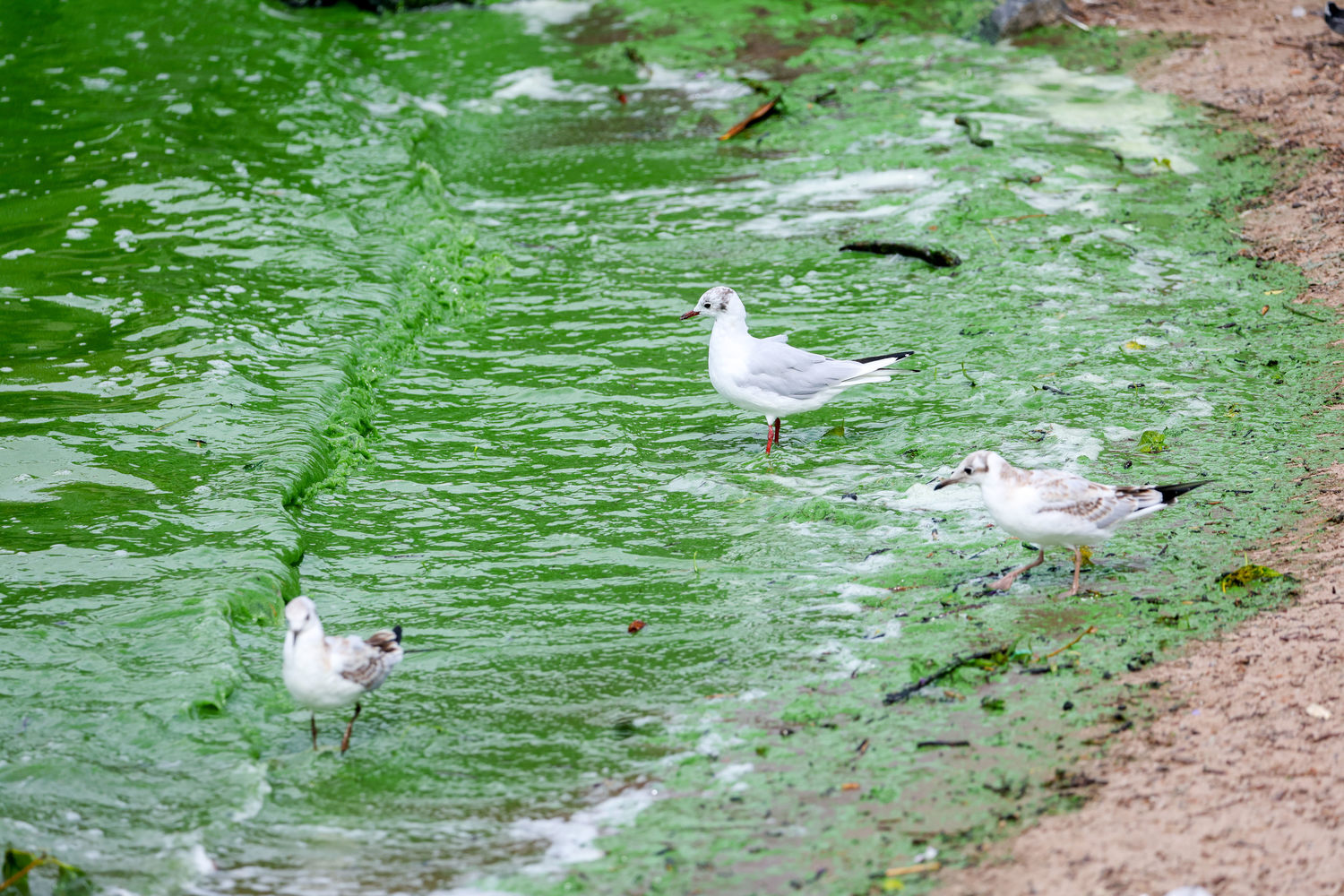
Pollution caused by agricultural runoff and sewage at Lough Neagh in 2024. Photo by Jonathan Porter, Press Eye
***
Some researchers believe these toxic bacteria – a number of which are found in the human gut and which suggest the presence of raw faecal matter in the water – played a critical role in a cluster of dog deaths reported around both the eastern and western shores of the lough as far back as early 2022.
‘I’d be flabbergasted,’ says Neil Reid, a conservation biologist from QUB, ‘if the animal deaths were not down to contaminants in the lough’s waters at the time.’ He tells me how he had heard the previous year of a friend’s dog having run through the water at Woodburn Forest by Carrickfergus, a coastal town around thirty miles eastwards, sitting above Belfast. Just a few hours later, the dog began to vomit, becoming violently sick. It died within twenty-four hours.
Throughout the summer of 2023, Reid, who lives within the wetland basin area between Lough Neagh and the neighbouring Lough Beg, had made a number of applications to UK research funding bodies that support time-sensitive work responding to various kinds of manmade or natural disaster events. Having been knocked back on each occasion, he decided to take matters into his own hands. The lough-shore researcher managed to pull together a relatively modest amount of internal funding, he says, and set out to establish what exactly was in the water.
Dressed in full waterproof Personal Protective Equipment, reminiscent of health and emergency workers during the recently subsided Covid-19 pandemic, Reid hired a boat and started taking samples at four separate sites. After each day out on the water, he says, he spent ‘three or four hours in the lab during the evening’ processing his samples. However, even this limited exposure to the water’s noxious contents took its toll, a telling indicator of the bacterial toxins’ potency, given the expectation that water would need to be ingested to cause ill-effects. ‘I was opening the containers in the lab and the smell was so bad that I had to open all the windows,’ he says. ‘I had to prop open the doors so that there was wind. When I went home on each of those nights, I had a headache and I felt nauseous.’ Clearly, toxins were being aerosolised, so much so that some families around the lough reported having to leave their homes during 2025’s late summer blooms, given the nausea and disruptions to sleep they were said to be inducing.
On the issue of the dogs’ deaths, Reid explained:
When the dogs lap up the water, they’re clearly ingesting these toxins. And their deaths cannot be explained by, for example, a bacterial infection, getting E. coli from this, because it would take days for them to succumb to something like that. The rapidity, the swiftness of the sickness and deaths we saw is certainly consistent with [the effects of] these neurotoxins that are there.
Reid’s research confirmed many of the worst suspicions about the dangers posed by this commixture of contaminants. His findings made dismal reading for the lough’s beleaguered shoreline businesses, already fatigued by the negative publicity swirling around these public health concerns.
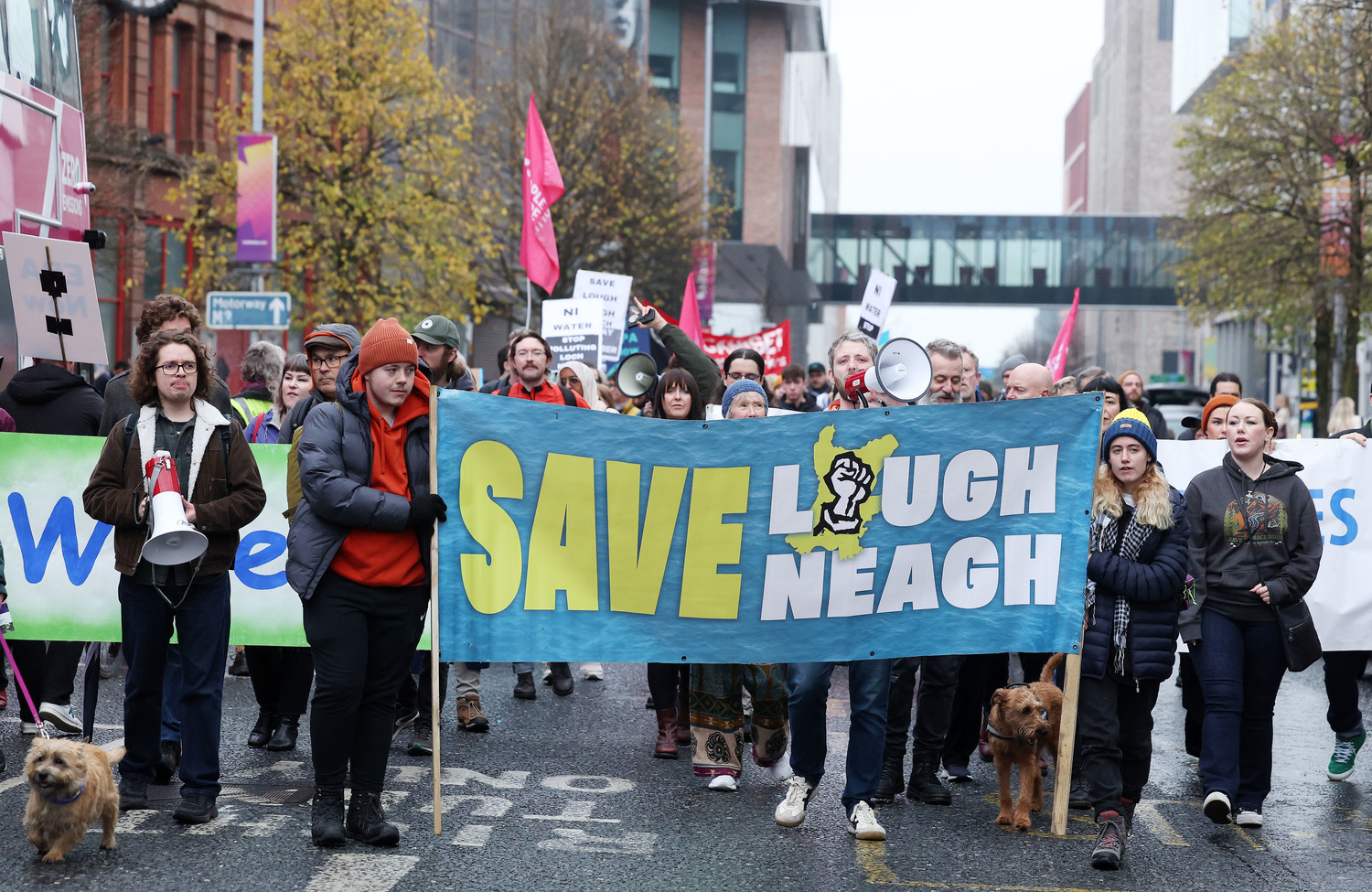
Protesters in Belfast highlight the ongoing issue of water pollution in Lough Neagh. Photo by Jonathan Porter, Press Eye
***
For one local business owner, there had been more to contend with than simply adverse PR. The Edge Watersports, a shop for outdoor water pursuits at the Cranagh Activity Centre along the Lower Bann, was one of the first businesses to announce permanent closure in 2023 as a direct consequence of the algal blooms. Rob Skelly, the man who had run the outfit for nearly thirty years, appeared utterly despondent around twelve months on from the first arrival of the blooms. Speaking in summer 2024 to the News Letter, as cyano-bacteria growths began to sweep the lough once again, he was scathing about what he considered an almost non-existent government response to the crisis.
‘We were just wiped out last summer and it’s not coming back,’ he said. ‘Absolutely nothing has changed since last year in the lough. The only reason that it isn’t worse now is because the weather has been quite poor, but as soon as we get a blink of sunshine it will be the same again.’
He told the author that he had gone into 2023 ‘relatively optimistic’ after a bumper year in 2021 and healthy returns the following season. But by August the ‘green flecks’ he had initially seen in the water had spread quickly, accumulating in ‘thick clumps’ at the river’s edge and permeating the flowing water. The river had become ‘like Chicago on St Patrick’s Day’, he recalled, with the algae in ‘full suspension right the way down for two or three metres’. Despite some short-lived attempts to resurrect the business, Skelly soon began to realise this would have long-term implications.
Skelly recalled a sense of indifference bordering on negligence when contacting public authorities for support. He said he was on the phone ‘for around five hours’ one day, simply being ‘passed around’ by the local council’s pollution hotline, then three Stormont departments, only to ‘end up back where I’d been at the very start’, speaking to the same council worker. Each authority insisted ‘they could do nothing to help’, and ‘nobody was prepared to give any sort of steer on it whatsoever’. A letter from Mike Brennan, then a permanent secretary at the Department for the Economy, which bluntly stated, ‘The closure will be a loss for communities and visitors alike’, added insult to injury for Skelly.
Scientists at the advisory Agri-Food Biosciences Institute (AFBINI) had, towards the end of autumn 2023, predicted that it would take at least two decades for legacy phosphorus to be removed from the lough. These were contaminating nutrients locked in the sediment of the lough bed that a research briefing paper to the Stormont Assembly found can take more than forty years to clear. By the time algal blooms returned to the lough’s shores in 2024, between 15,000 and 20,000 tonnes of additional phosphorous were estimated to have entered the lough system.
Skelly was understandably pessimistic, not just about the prospect of resurrecting his business, but also about seeing a clear reversal of the lough’s for-tunes within his lifetime. ‘I would love to start my business again,’ he added but said he had just been ‘on a Zoom call with the Institute of Biosciences’ who delivered grim turnaround time-frame news. Noting the decades-long clean-up ahead – so long as ‘they stopped all pollution going into Lough Neagh tomorrow, and there’s not a major intervention’ – the fifty-three-year-old business owner noted ‘that might only come within my kids[’] lifetime.’
The proposed time frame forced a deep, far-reaching readjustment of expectations and plans among the collection of miscellaneous small traders around both the lough and its connecting waterways. It was also a devastating blow for those in the region’s tourism sector, which was belatedly seeking to promote what, for many, had long been considered a relatively unspoiled beauty spot.
Tommy Greene will be at Belfast bookshop No Alibis this Thursday (26th) to launch his book, in conversation with journalist Sam McBride and special guest speaker Bernadette Devlin McAliskey. Tickets here.